
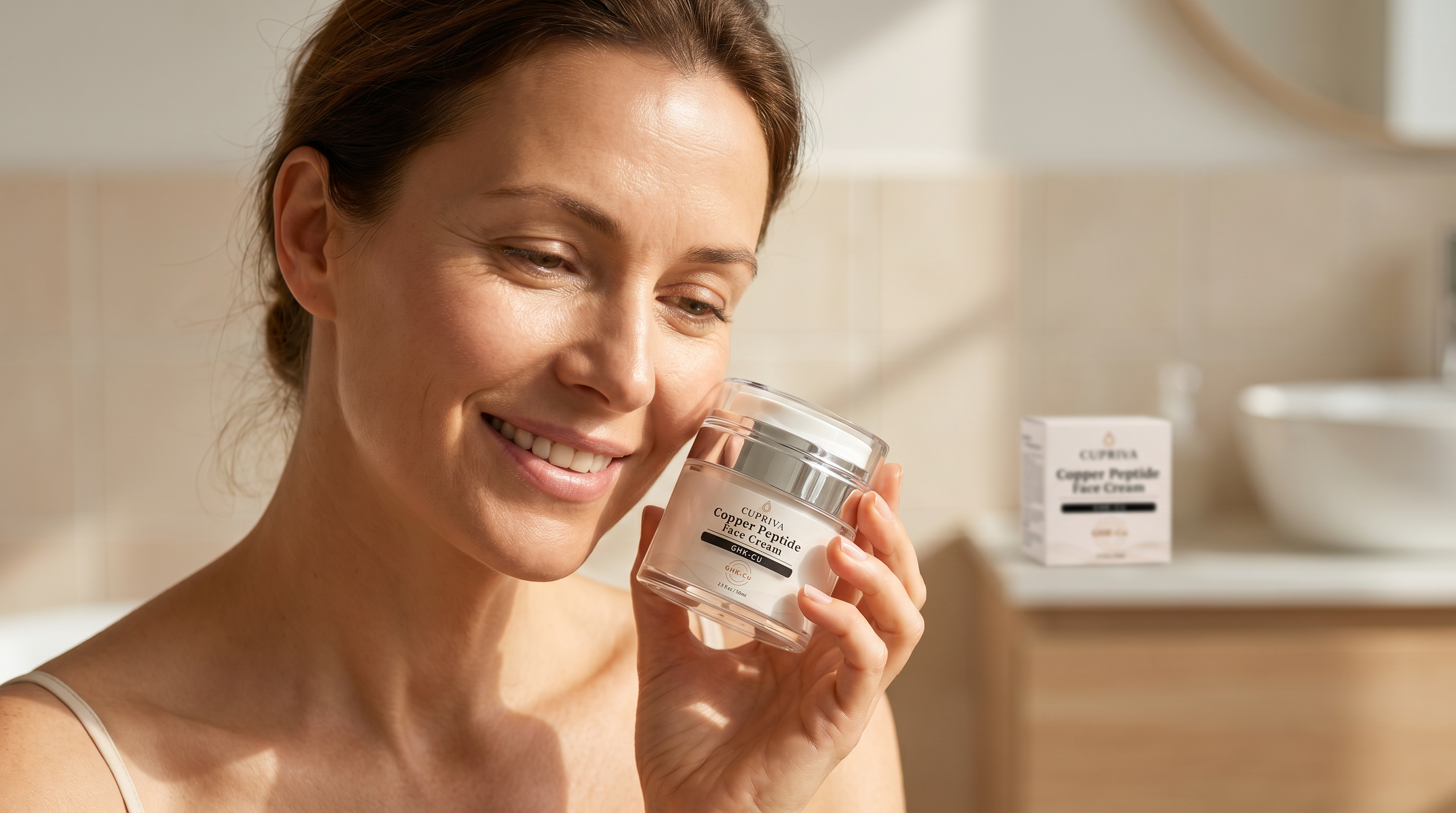

Anyone seriously interested in anti-aging skincare will sooner or later come across an active ingredient that stands out from the crowd — not because it is new, but because it is unusually well-researched: GHK-Cu, also known as Copper Tripeptide-1 or copper peptide.
While the cosmetics industry jumps from trend to trend, GHK-Cu has received more scientific attention since its discovery in 1973 than most active ingredients advertised in expensive creams today. Yet, relatively few people in Germany know about it. We wrote this article to change that — objectively, without marketing promises, and with genuine source references.
What is GHK-Cu?
GHK-Cu stands for Glycyl-L-Histidyl-L-Lysine-Copper — a tripeptide made of three amino acids bound to a copper ion. It occurs naturally in human blood plasma, saliva, and urine, and acts as a body-own signal molecule.
The story began in 1973 in the laboratory of Dr. Loren Pickart at the University of Minnesota. Pickart was investigating why liver tissue from young people regenerated differently in the lab than that of older people. He isolated the decisive factor in young plasma: a tiny molecule that he initially called only a "regeneration signal" — which turned out to be GHK.
A few years later, it became possible to bind the molecule to a copper ion, significantly improving its stability and efficacy. What began as a specific research interest developed over decades into one of the most studied cosmetic ingredients ever.
In short: GHK-Cu is not a synthetic foreign substance that the skin must tolerate. It is a molecule that the body produces itself — and one that it has less of as we age.
Why does GHK-Cu decrease with age?
GHK-Cu is not an invention of the cosmetics industry — it is part of the body's own biochemistry. In the blood plasma of a 20-year-old, levels are measurably high. The problem: with every decade of life, they drop noticeably.
at 20 years old
at 60 years old
endogenous levels
This decline is no coincidence. GHK-Cu plays an active role in the body in regulating repair and renewal processes. As levels drop, the body's capacity for tissue regeneration decreases — and this is particularly visible in the skin: less elasticity, slower cell renewal, and decreasing density.
The idea behind GHK-Cu skincare is therefore very simple: to give the skin back what time takes away — in a concentration that actually works.
How does GHK-Cu affect the skin?
GHK-Cu works on several levels simultaneously — this is one of the reasons why, after five decades, researchers are still discovering new aspects of its biology.
1. Collagen and Elastin Synthesis
GHK-Cu activates fibroblasts — those cells in the dermis responsible for producing the structural proteins collagen and elastin. The result — if the concentration and formulation are correct — is visibly firmer, denser skin.
2. Gene Regulation and Cell Renewal
GHK-Cu does not just influence individual signaling pathways but regulates the activity of over 4,000 human genes. Many of these genes are linked to tissue renewal, DNA repair, and anti-inflammatory processes.
3. Antioxidant Protection
Copper ions play an important role in the body's antioxidant defense. GHK-Cu is linked to increased activity of copper-dependent enzymes — enzymes that can neutralize free radicals.
GHK-Cu acts like a reset signal for the skin — it reminds the cells how they functioned when they were younger.
What does the research say?
GHK-Cu is one of the longest continuously studied peptides in dermatology. The findings have been examined over many years by various research groups using different methods.
An honest assessment is important: a large portion of the findings comes from in-vitro studies and animal models. Clinical studies on human skin on a larger scale are — as with many cosmetic active ingredients — less common, but they do exist.
Frequently cited findings include a measurable increase in skin thickness after several weeks of use, improved hydration due to increased hyaluronic acid production, and reduced wrinkle volume in comparative studies.
Important: Study results depend heavily on concentration, formulation, and delivery system. A cream with 0.01% GHK-Cu is not comparable to a formulation with 1%.
GHK-Cu vs. Retinol — an honest comparison
Anyone interested in anti-aging skincare cannot avoid retinol. So, what are the real differences compared to GHK-Cu?
| Criteria | ◆ GHK-Cu | Retinol |
|---|---|---|
| Mechanism of action | Endogenous signal | Vitamin A derivative |
| Tolerance | Very high | Irritation common |
| Adjustment phase | None | 4–12 weeks possible |
| UV sensitivity | Not a photosensitizer | Increased light sensitivity |
| Pregnancy | No known restrictions | Contraindicated |
| Collagen effect | Direct fibroblast activation | Collagen stimulation via irritation |
| Suitable for | All skin types | Normal to oily skin |
- Mechanism: Endogenous signal
- Tolerance: Very high
- Adjustment: None
- UV sensitivity: Not a photosensitizer
- Pregnancy: No known restrictions
- Collagen effect: Direct fibroblast activation
- Suitable for: All skin types
- Mechanism: Vitamin A derivative
- Tolerance: Irritation common
- Adjustment: 4–12 weeks possible
- UV sensitivity: Increased light sensitivity
- Pregnancy: Contraindicated
- Collagen effect: Collagen stimulation via irritation
- Suitable for: Normal to oily skin
The conclusion is not that one is fundamentally better than the other. Retinol is highly effective for many users — but it comes with conditions. GHK-Cu is generally better tolerated, has no adjustment phase, and is particularly suitable for people who have not tolerated retinol or are looking for a gentle alternative.
Which concentration is effective?
GHK-Cu is an active ingredient where concentration is crucial. Many products advertise GHK-Cu without stating the concentration used.
of many market products
used in studies
measurable effect
As a rule of thumb: measurable cellular effects begin to appear from about 0.5% GHK-Cu. Many clinical observations were achieved with formulations between 1% and 3%.
How do I recognize a good GHK-Cu product?
1. Concentration is specified
A reputable manufacturer communicates how much GHK-Cu is contained in the product.
2. Independent lab testing
The GHK-Cu concentration is measurable. Independent lab tests are a strong proof of quality.
3. Formulation and carrier
GHK-Cu is water-soluble and relatively small. However, the delivery system is important, as it can influence stability and penetration.
4. Storage and packaging
Copper peptides are sensitive to light and oxidation. Airless pump systems are therefore better suited than open jars.
5. Combination of active ingredients
GHK-Cu combines well with niacinamide, hyaluronic acid, and panthenol. Caution is advised when using it simultaneously with L-ascorbic acid or strong AHA/BHA acids.
CUPRIVA was developed according to exactly these criteria: 1% GHK-Cu, independently lab-tested, in a cream formulation with Olivem 1000, hyaluronic acid, and niacinamide — filled in an airless pump container. More about the product →
Frequently asked questions about GHK-Cu
For which skin type is GHK-Cu suitable?
For all skin types. GHK-Cu does not cause classic peeling, purging, or dehydration. Sensitive skin also usually tolerates it well.
How long does it take for GHK-Cu to work?
Many users report a visibly brighter complexion after 1–2 weeks. Firming effects and denser skin texture typically appear after 4–6 weeks of consistent use.
Can GHK-Cu be used daily?
Yes. Daily use is possible and advisable. Unlike retinol, there is no classic acclimation phase.
Can GHK-Cu be combined with other ingredients?
Yes. It combines well with niacinamide, hyaluronic acid, panthenol, squalane, and vitamin E. Vitamin C in the form of L-ascorbic acid and strong AHA/BHA acids should be used at different times.
Is GHK-Cu the same as Copper Tripeptide-1?
Yes. GHK-Cu is the short scientific name; Copper Tripeptide-1 is the INCI name.
From what age does GHK-Cu make sense?
The body's own GHK-Cu levels begin to drop from about 25–30 years of age. Preventive use can make sense from this age onward.
Can you use GHK-Cu together with retinol?
Yes, but it is best to use them at different times. A possible routine would be GHK-Cu in the morning and retinol in the evening.
Is GHK-Cu safe?
GHK-Cu is considered very well-tolerated. As with any cosmetic product, individual intolerances to other ingredients may theoretically occur.
CUPRIVA — 1% GHK-Cu, lab-tested
The science behind this article in a formulation we stand behind with our name.
Go to product